Healthcare SEO and branding: our methods, decisions and illustrative examples
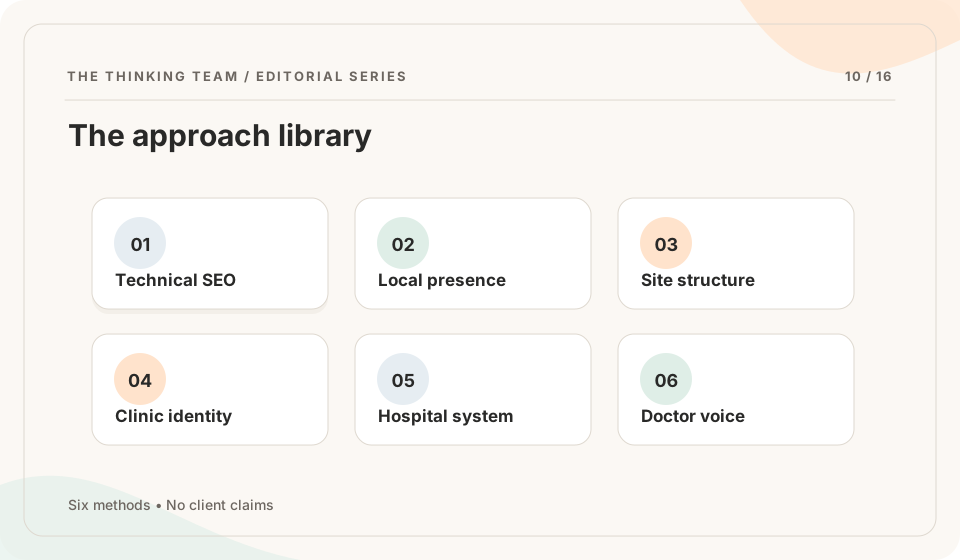
A useful agency portfolio should answer more than "Did the design look attractive?" or "How many pages did you publish?" It should make the problem, decision, work performed and available evidence understandable. Where public client permissions and dated outcome records are unavailable, we do not invent success stories. This library therefore contains **six illustrated approach guides**, not claims that six named or anonymous client engagements achieved particular results.
Explore the guidesExplore the six approach guides
Healthcare Technical SEO Audit: Illustrated Guide
An illustrated technical SEO audit: diagnosing redirects, crawl access, duplicate URLs and canonical problems without invented client results.
Local SEO Accuracy for Clinics: Illustrated Guide
An illustrated clinic local SEO scenario covering inconsistent addresses, genuine profile ownership, website accuracy and evidence-based checks.
Multi-location Hospital SEO: Illustrated Guide
An illustrated hospital SEO guide explaining branch architecture, department facts, URL mapping and distinct pages for legitimate locations.
Clinic Brand Identity: Illustrated Design Guide
An illustrated clinic branding story about inconsistent visuals, positioning, typography, handover templates and useful design governance.
Hospital Brand System: Illustrated Design Guide
An illustrated hospital branding guide to shared identity, departmental templates, governance and consistent information design.
Doctor Personal Branding: Illustrated Content Guide
An illustrated doctor branding story about distinctive specialist education, verified profiles, video editorial direction and review.
In this guide
Each guide begins with a plausible communication challenge, walks through the decisions a responsible team would make and identifies the artifacts needed to prove a completed project. The scenarios are explicitly illustrative. As permissioned evidence becomes available, selected guides can later be developed into genuine anonymised case reports with dated source material and approval from the appropriate parties.
Choose the kind of problem you are trying to solve
1. When Google cannot understand a healthcare website
A hospital website can look coherent to a human while serving contradictory canonical tags, missing service pages and broken redirects to search engines. Our technical SEO and crawl accessibility guide explains how to distinguish a real defect from an assumption, prioritise fixes and verify what was actually released. The story begins with a website change that seems harmless but risks making useful content disappear.
2. When a clinic's information disagrees across the web
The signage says one thing, the website another, and a directory carries an outdated contact. Which source should be corrected first? Our local-search consistency guide starts with verified ownership and real-world eligibility, then shows how to create a documented source-by-source correction process rather than a vague promise of "more Maps calls."
3. When several hospital locations compete with their own pages
A hospital group can end up with a homepage, duplicate department pages and near-identical locality templates competing for the same information need. The multi-location architecture guide explains how to map institution, campus, department and practitioner facts into an understandable page structure without inventing branches or erasing useful historical URLs.
4. When a clinic has a logo but no consistent identity
Every poster, brochure and social post may look like it belongs to a different organisation. The clinic identity guide explores the decisions behind positioning, typography, image direction and practical templates, showing why a reusable system is more valuable than a presentation full of disconnected mockups.
5. When a hospital's departments speak in different visual languages
One institution can contain dozens of information needs and many editors. The hospital brand-system guide shows how a master identity and sensible governance could maintain recognition while allowing each department to communicate clearly.
6. When a specialist doesn't want to repeat everyone else's reels
A doctor may already appear on the hospital website but have no distinctive professional voice. The doctor profile and educational-content guide explores how to build content around genuine expertise and verified facts rather than identical trending topics or unsupported claims.
What counts as evidence in a real case study?
A credible published case needs a defined client problem, documented scope, dated deliverables, permission to publish the relevant material and a clear explanation of what changed. SEO evidence might include URL-level audits, deployment logs, Search Console time periods, accessible before/after pages and carefully interpreted query trends. Branding evidence could include approved identity systems, rights-cleared applications and attributable stakeholder feedback. The standards are different because the work is different.
A case report must distinguish outputs (the work delivered), observations (what was measured after release) and attribution (what the evidence actually allows us to credit to the work). It must not imply that a better clinical outcome, increase in consultations or higher Google rank occurred without reliable records and the right approvals.
How we decide what to publish
We first obtain confirmation that a project can be discussed. We remove identifiers where anonymity is required, but anonymity alone is not permission to publish confidential facts. Claims about medical information, practitioners, patient material or professional achievements receive the applicable clinical and legal reviews. We avoid patient testimonials and comparative medical claims used as promotional proof.
Where permission is unavailable, an illustrative method guide is still valuable when clearly labelled. A reader can assess the reasoning without being misled into thinking that a hypothetical story is a completed engagement. Google also emphasises original, helpful content supported by clear authorship and trust signals in its people-first guidance.
What a prospective client can learn from the guides
Use the six approaches as a checklist for evaluating any agency. Ask whether technical recommendations are actually deployed, whether the branding system works for your team's everyday materials, whether every local business location is genuine, whether approvals are recorded and whether reported performance has a clear source and date. An agency should be comfortable explaining the limits of its evidence as well as its deliverables.
For service scope rather than illustrative examples, visit healthcare SEO and healthcare branding. For medical communication controls, see ethical healthcare communication.
Frequently asked questions
Are these six examples completed client case studies?
No. They are explicitly labelled illustrative approach guides. We will not present them as actual completed engagements or claim performance results that cannot be substantiated.
Why are client names not shown?
Public project material needs the right permissions. We can explain our working methods without using another organisation's identity or confidential information.
Can a real project be published anonymously?
Potentially, with suitable publication rights, factual evidence and review of any remaining identifying details. Anonymity is not a substitute for consent.
Will you provide a sample audit or brand deliverable?
A scoped discussion can identify what type of template or example is appropriate to share. Any actual client artifact requires rights clearance and removal of confidential information.
Have a similar problem?
Describe the website, identity or communications challenge—not patient information. We can explain how we would scope the problem, which facts need verification and what an accountable first deliverable should look like. Talk to The Thinking Team.
Your expertise deserves
a thoughtful brand.
Tell us where you are today and what you want to build next. We’ll start with the right questions.